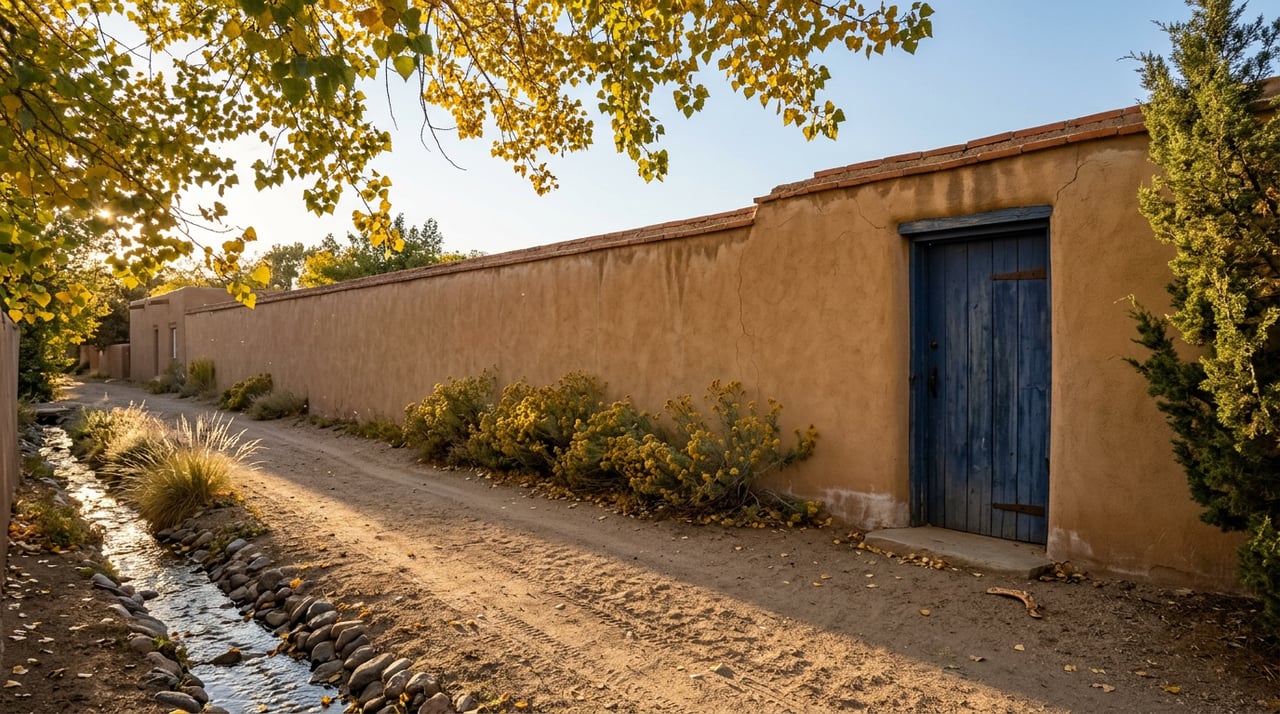
Most guides to Canyon Road treat it as a destination: park, browse, eat, leave. If you already live on the East Side, that framing is useless. The half-mile of galleries is one segment of a much longer corridor that runs from Paseo de Peralta all the way to a nature preserve, and the fall calendar is built around walking it, not driving to it.
Here is the case for treating Canyon Road as the middle of your route rather than the endpoint, and the two October dates that make the argument obvious.
The corridor, not the strip
Canyon Road holds the highest density of galleries in the US, more than one hundred along a half-mile, tree-lined stretch. That statistic gets repeated everywhere. What it leaves out is that the same half-mile sits inside a seven-mile walking route that most visitors never touch.
A casual walk from Paseo de Peralta up through Acequia Madre, along Canyon Road, and out to the Randall Davey Audubon Center runs roughly seven miles round trip, about two and a half hours on foot. That is the loop worth learning if you live within it.
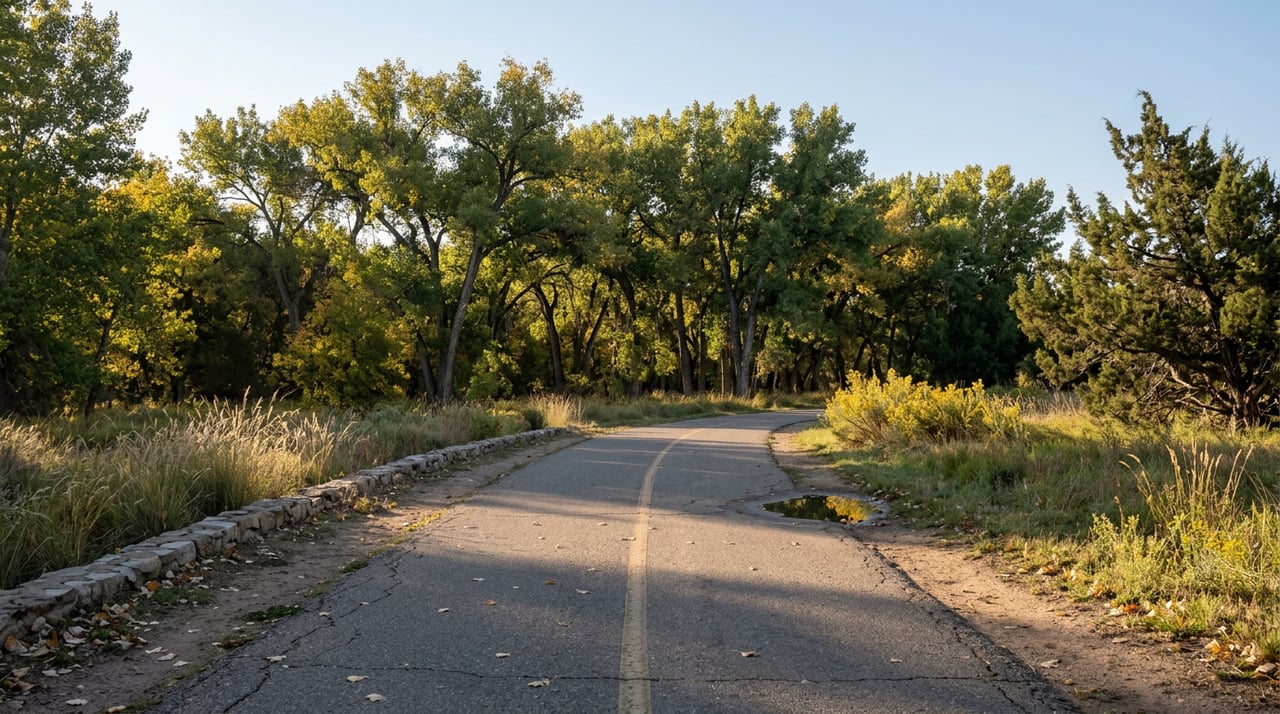
The connective tissue is water. Acequia Madre, the irrigation ditch running parallel to Canyon Road, dates to 1706. At seven miles long including its laterals, it has by far the most volume of any acequia in the city, flowing from its origin at East Alameda and Los Cerros Reservoir down to Agua Fria Village. When it runs, you can walk beside it for most of its length.
The seven-mile route, waypoint by waypoint
Starting from the west end at Paseo de Peralta and moving east, the sequence rewards a slow pace:
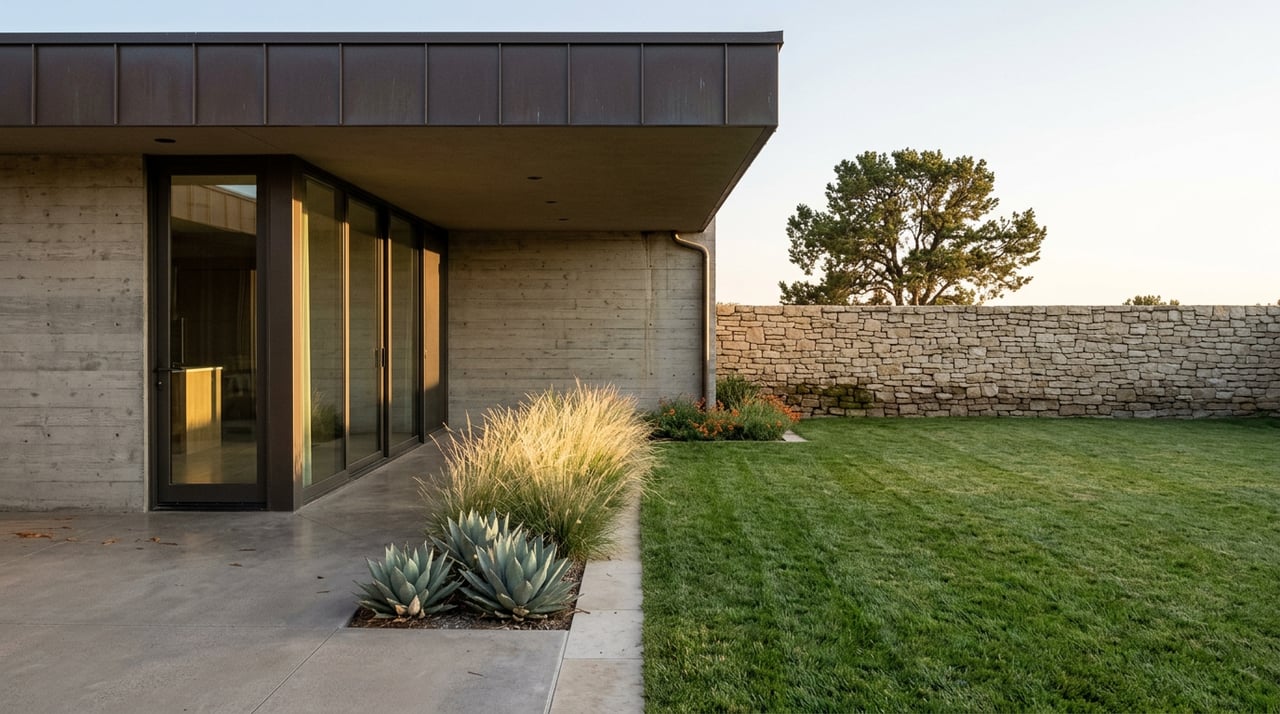
Nedra Matteucci Galleries at the base of Acequia Madre. The garden holds sculptures and fountains before you ever step inside, where contemporary and historical paintings share the walls. Free, quiet, and a useful bearing point for the walk east.
The Garcia Street corner. A small commercial building at Garcia Street houses two local favorites, including a bookstore and Downtown Subscription for coffee. Kakawa Chocolate House is a short detour to the north if you need a cacao elixir before the climb.
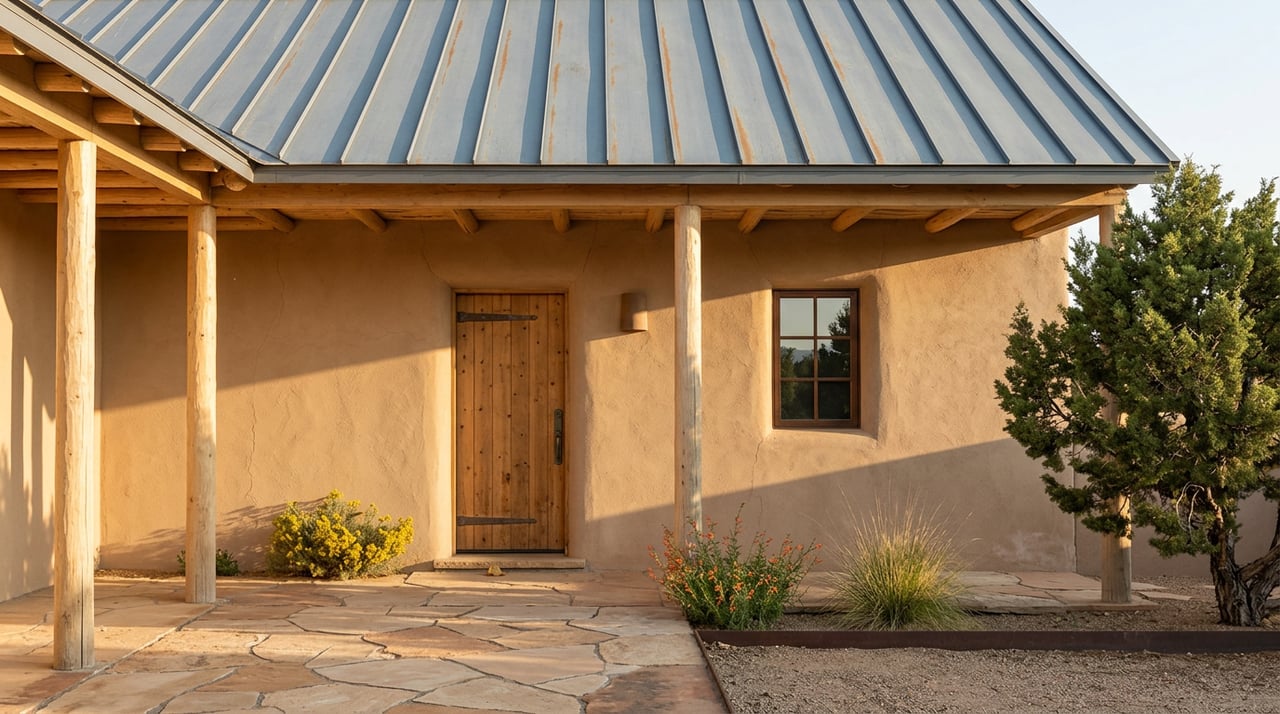
El Zaguán. In 1854, James Johnson connected building upon building here to house his large family, and a later owner named the property El Zaguán, Spanish for a passage or hallway. The garden is open to the public and worth ten minutes.
Patrick Smith Park, where Acequia Madre meets Canyon Road. Named after Monsignor Patrick Smith, a longtime pastor at the adjacent Cristo Rey Church, the park offers a playground, picnic tables, and access to the Santa Fe River.
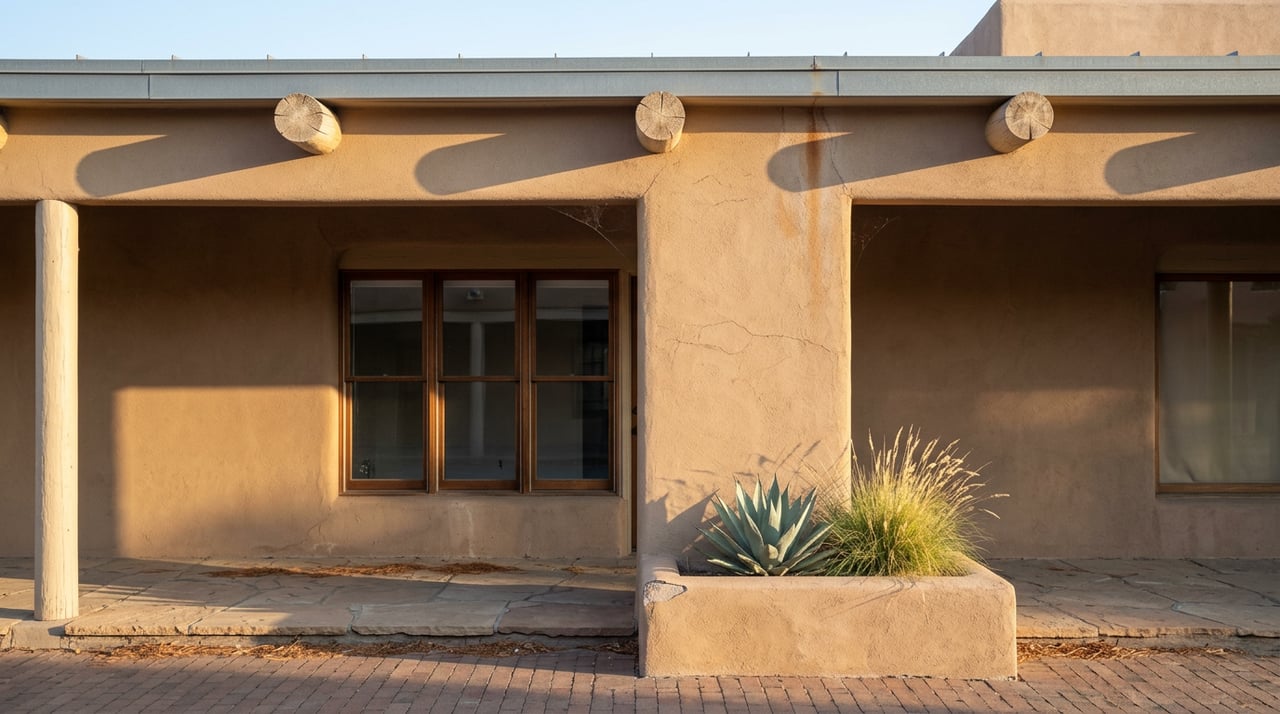
Johnnie's Cash Store. In business since 1946 at 420 Camino Don Miguel, this brick-by-brick adobe holds tamales, cold drinks, and a bit of neighborhood lore.
The Canyon Road galleries themselves. More on the two fall dates below.
The 1895 hydroelectric site. Where Canyon Road meets Camino Cabra, a one-block detour brings you to the site of Santa Fe's first hydroelectric power plant, built in 1895 and now preserved as a historic site and park.
Randall Davey Audubon Center. Continue up Upper Canyon Road to where it meets Cerro Gordo, and the last stretch of Canyon Road ends at the Audubon Center and Sanctuary. The Nature Conservancy owns hundreds of adjacent acres, protecting the old rock work from the reservoirs that once supplied Santa Fe's drinking water, and the trails connect north to the Dale Ball system.
South Dale Ball trailhead and Picacho Peak. The trailhead to the South Dale Ball trails sits back along Cerro Gordo. Picacho Peak, part of the Dale Ball system, starts near the Santa Fe Canyon Preserve at the top of Upper Canyon Road and offers a slightly shorter alternative to Atalaya with similar views. Its trailhead is at the parking area at the end of Upper Canyon Road.
The point is that a resident can string together a bookstore, a coffee, a chocolate shop, six historic sites, one hundred galleries, and a foothill trail without ever getting into a car. That is not a claim you can make about most Santa Fe neighborhoods.
What to do about the ditch
"When flowing at near-historic volumes, the Acequia Madre performs a kind of magic trick, becoming a portal to the past and a living cultural artifact, a physical example of what life used to look like in Santa Fe."
Whether the ditch is running when you walk it depends on the winter snowpack and the current year's water share. In dry years the bed is grass and gravel. In wet ones the water gurgles alongside the dirt path between the ditch and the curb. Either way, the trees planted alongside it, including the cottonwoods around the Randall Davey property, are the reason the corridor is shaded in a way most Santa Fe streets are not.
October 19: the Paint & Sculpt Out
This is the fall date to plan around. The Historic Canyon Road Paint and Sculpt Out takes place on Saturday, October 19, from 11:00 a.m. to 3:00 p.m., with many artists starting earlier, and encompasses the full half-mile of Canyon Road galleries for a day of community, art, and conviviality.
What it actually looks like on the ground: sculptors, potters, painters in every medium, designer jewelers, and photographers work in sculpture gardens and inside adobe interiors along the road, interacting with visitors and discussing their techniques throughout the day. Artists bring live models, paint, clay, carving knives, blow torches, easels, and materials from their studios, and begin working on the road itself.
If you go, a few gallery-specific notes from this year worth knowing:
- Canyon Road Contemporary Art has relocated to a new space at 409 Canyon Road, down the street from its old location. If you have not been by since the move, this is the day to correct that.
- Ventana Fine Art at 400 Canyon Road, in the historical red brick schoolhouse, has anchored the road for more than 44 years and typically hosts one of the largest painter and sculptor lineups on the day.
- Gerald Peters Gallery, in the large Spanish Pueblo building with a sculpture garden out back, opens more exhibit space than usual for the event.
Parking is the reason to walk in rather than drive. Even in a normal weekend, parking on Canyon Road can be difficult, and leaving the car behind is the standing advice. On the third Saturday in October, that advice hardens into a rule.
The lower-key alternative: First Wednesdays
If October 19 is too much of a crowd for your taste, the summer version runs monthly. On the first Wednesday of each summer month, the community gathers for an amble with food, music, and arts and crafts along Canyon Road. The evening Art Stroll extends the pattern into the shoulder season: galleries and boutiques from Paseo de Peralta to Camino del Monte Sol stay open into the evening, some until 7 p.m., for a stroll from gallery to gallery.
Two rhythms, then, for the fall calendar:
| Event | Date | Hours | Character |
|---|---|---|---|
| First Wednesday Art Walk | Monthly through summer | Late afternoon into evening | Neighborhood pace, food and music |
| Historic Canyon Road Paint & Sculpt Out | Saturday, October 19 | 11 a.m. to 3 p.m. | Full half-mile, live demonstrations |
Why the loop matters more than the date
Any weekend visitor can show up on October 19 and see the Paint & Sculpt Out. What they cannot do is what a resident can, which is to build the day around the walk instead of around the event. Coffee at Garcia Street, an hour in the galleries, tamales at Johnnie's, an afternoon at the Audubon center, and back down through the acequia as the light drops. The event becomes a segment of the day rather than the whole of it.
That is the argument for staying on foot, and for treating the East Side as a corridor with two long ends and a dense middle. The galleries are the middle. The water and the trailheads are the ends. Most guides only tell you about one of the three.
If you are considering a property along this corridor or already own one and want to understand how the walking geography shapes long-term value, Giorgetti Realty is happy to talk it through. Contact us.